Zinaida Yevgenyevna Serebriakova (née Lanceray) was a Ukranian/Russian painter active in the early 20th century.
Born near what is now Kharkiv, Ukraine into a well-to-do family, she studied at an art school under the direction of Ilya Repin, and went on to study with noted portraitist Osip Braz. She also traveled to Italy and Paris, studying at museums where possible.
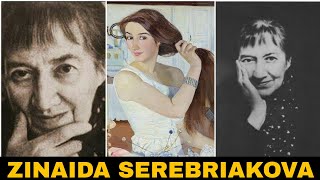
Her work over time carried elements of Realism, Impressionism, Art Nouveau and Expressionism. Her subjects included landscape, still life and figures, but her primary interest was portraiture. In addition to portraits both formal and informal, she frequently painted and drew her children and created several self-portraits, the most famous of which (image above, top) helped establish her career.
She also found dancers of particular interest, featuring them in many compositions, as well as her own daughter in dancers garb from her classes (above, bottom).
Serebriakova worked in oil, water media and pastel. Some of her pastels of dancers have a Degas-like character.
After a tragic period following her husband’s sudden death, the rise of the Soviet Union and the closing of its borders left her in France, unable to return, and separated her from her two eldest children for a number of years. She eventually took French citizenship, residing in Paris for the remainder of her life. She traveled extensively and a number of her works are from her travels in Morocco and North Africa.
инаида Евгеньевна Серебрякова 1884-1967, was the first female Russian painter of distinction, as a master of portrait, genre scenes from the life of peasantry. She was born near Kharkov into one of Russia's most refined and artistic families. In 1900 she entered the art school founded by Princess M. K. Tenisheva. She studied under Repin in 1901, and Braz between 1903-1905. Between 1902-1903 she spent time in Italy, and from 1905-1906 she studied in Paris. At the outbreak of the October Revolution in 1917 Serebriakova's life suddenly changed. In 1919 her husband Boris died of typhus contracted in Bolshevik jails. She was left without any income, responsible for her four children and her sick mother. She did not want to switch to the futurist style popular in the art of the early Soviet period, nor paint portraits of commissars, but she found some work at the Kharkov Archaeological Museum.
Category :
ALLONE
#zinaida#serebryakova#1884#1967#russian#realist#painter